The FDA record for the original approved product, a diagnostic agent used to assess how well the pituitary releases growth hormone. A second approval in 1997 (NDA 20-443) covered treatment of growth hormone deficiency in children. Both are listed as discontinued, and there is no FDA-approved sermorelin on the market today.
Sermorelin
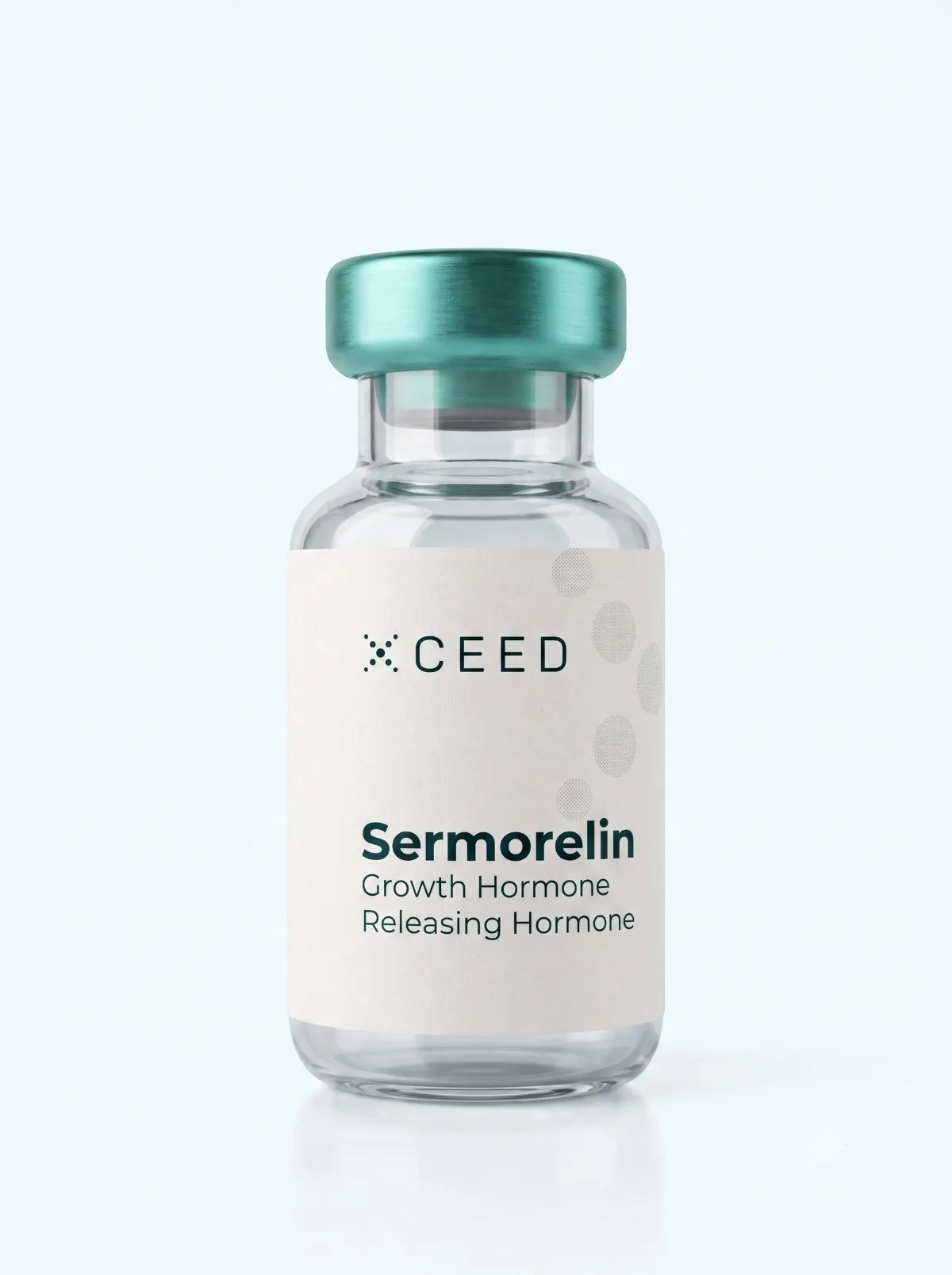
Sermorelin is a synthetic analog of growth hormone-releasing hormone (GHRH). It was an FDA-approved medication until 2008 and is now prepared by compounding pharmacies. Here is what it is, what the evidence does and does not show, and how it works through a licensed physician.
Included with every protocol
- Coaching and the Avida app — included, at no extra cost
- Physician review before it ships, and monitoring while you are on protocol
- Delivered to your door by a licensed US pharmacy, refills managed for you
Physician-reviewed before it ships
What it is
What sermorelin is
Sermorelin, or sermorelin acetate, is a synthetic peptide made of the first 29 amino acids of human growth hormone-releasing hormone, the natural signal the body uses to prompt the pituitary gland to release growth hormone. That 29-amino-acid fragment is the active part of the full 44-amino-acid hormone. Pharmacologically, it raises growth hormone by stimulating the pituitary to release it, rather than supplying growth hormone directly. It was first approved by the FDA in 1990 under the brand name Geref, with a second approval in 1997 covering treatment of growth hormone deficiency in children. Beyond that established mechanism, we make no claims about what sermorelin will do for you. Whether it fits your goals is a decision for a licensed physician.
The evidence
What the research says, and what it does not
Sermorelin's mechanism is well established, and the FDA approved it decades ago for a diagnostic use, assessing how well the pituitary releases growth hormone. The evidence for the wellness and age-management uses people explore today is much thinner. The original approval was for diagnosis, not for anti-aging or body composition, and there are no large modern human trials supporting those uses. We present the research so you can be informed and ask your physician detailed questions. We make no claims about what sermorelin will do for you.
A five-month single-blind, placebo-controlled study in 19 adults aged 55 to 71, measuring hormonal and body-composition changes during nightly injections of a GHRH analog. Results differed between men and women, so it is not a general body-composition finding.
An early human study measuring growth hormone and IGF-I levels in older men during twice-daily administration of GHRH(1–29). It measured hormone levels only, not health outcomes.
A six-week study in 11 men aged 64 to 76, measuring growth hormone secretion, muscle strength, muscle energy metabolism and body composition during single nightly GHRH(1–29) injections. Nocturnal growth hormone release rose, IGF-I did not change, and only some strength measures improved.
This review is about growth hormone itself, not sermorelin. It pooled trials in healthy older adults and reported small changes in fat and lean mass without improvements in strength or fitness, alongside higher rates of adverse effects.
A professional-society review of hormonal change with age. It concludes that growth hormone is not recommended as an anti-aging therapy.
A controlled trial of GHRH and cognitive function. About half the participants had mild cognitive impairment, so the findings do not apply to healthy adults, and nothing here should be read as a claim about memory or focus.
How to read this list: sermorelin's mechanism is FDA-reviewed fact, and its original approval was for diagnosis. The human studies above measure hormone levels, not health outcomes. The two sources that do measure outcomes, Liu 2007 and the Endocrine Society statement, are about growth hormone rather than sermorelin, and neither is favourable. We do not assume that growth hormone results transfer to sermorelin.
Safety
Safety and what to discuss with your physician
Sermorelin is generally well tolerated. The most commonly reported effects are reactions at the injection site, such as redness, swelling, or discomfort. Some people have reported flushing, headache, dizziness, nausea, or a change in taste. Because it acts on the growth hormone system, a licensed physician reviews your history, decides whether it is appropriate for you, and monitors you while you are on protocol. People who are pregnant or breastfeeding, and anyone with a significant medical condition, should review it with a physician first. Competitive athletes should note that growth hormone secretagogues, including sermorelin, are prohibited under WADA rules.
The process
How to get sermorelin through XCeed
Tell us your goal
Complete a short medical intake.
A physician decides
If a protocol is right for you, they prescribe it. If it is not, they tell you.
Delivered, with a coach
A US-based pharmacy dispenses it, and the Avida app and a coach come with it.
Was sermorelin FDA-approved?
Yes, historically. Sermorelin was first approved by the FDA in 1990 under the brand name Geref, as a diagnostic agent, and again in 1997 for treating growth hormone deficiency in children. Both products were discontinued in 2008 for commercial reasons rather than safety, and the approvals were withdrawn in 2009. There is no FDA-approved sermorelin product on the market today. The sermorelin available now is compounded by a licensed pharmacy and is not FDA-approved as a finished product. It is prescribed by a licensed physician and dispensed by a licensed US-based pharmacy.
Questions
Frequently asked questions
Is sermorelin FDA-approved?
It was, as Geref, until 2008. There is no FDA-approved sermorelin product today. What you would receive is compounded and is not FDA-approved as a finished product.
What is sermorelin?
A synthetic peptide, the first 29 amino acids of growth hormone-releasing hormone, that stimulates the pituitary to release growth hormone.
Do I need a prescription?
Yes. A licensed physician reviews your intake and decides whether it is appropriate before anything is dispensed.
How is it taken?
By subcutaneous injection, or as an oral tablet that dissolves under the tongue. Your physician sets the specifics and can help you choose between them.
What does the evidence show?
Its mechanism is well established and it was approved for a diagnostic use. Evidence for today's wellness and age-management uses is limited, and we do not claim a result.
Can competitive athletes use it?
Growth hormone secretagogues, including sermorelin, are prohibited under WADA rules. Athletes subject to anti-doping should not use it without understanding that.
Start here
Want to talk to a physician about sermorelin?
Start with a short intake. A licensed physician decides what, if anything, is right for you.