Longevity

NAD+

NAD+ is a coenzyme found in every living cell, central to how cells produce energy. It is offered as a compounded injectable and as an oral melt. Here is what it is, what the research does and does not show, and how it works through a licensed physician.

Compounded. Not FDA-approved. Prescription only.
Coenzyme Compounded Injection or oral Prescription only

Included with every protocol

  • Coaching and the Avida app — included, at no extra cost
  • Physician review before it ships, and monitoring while you are on protocol
  • Delivered to your door by a licensed US pharmacy, refills managed for you
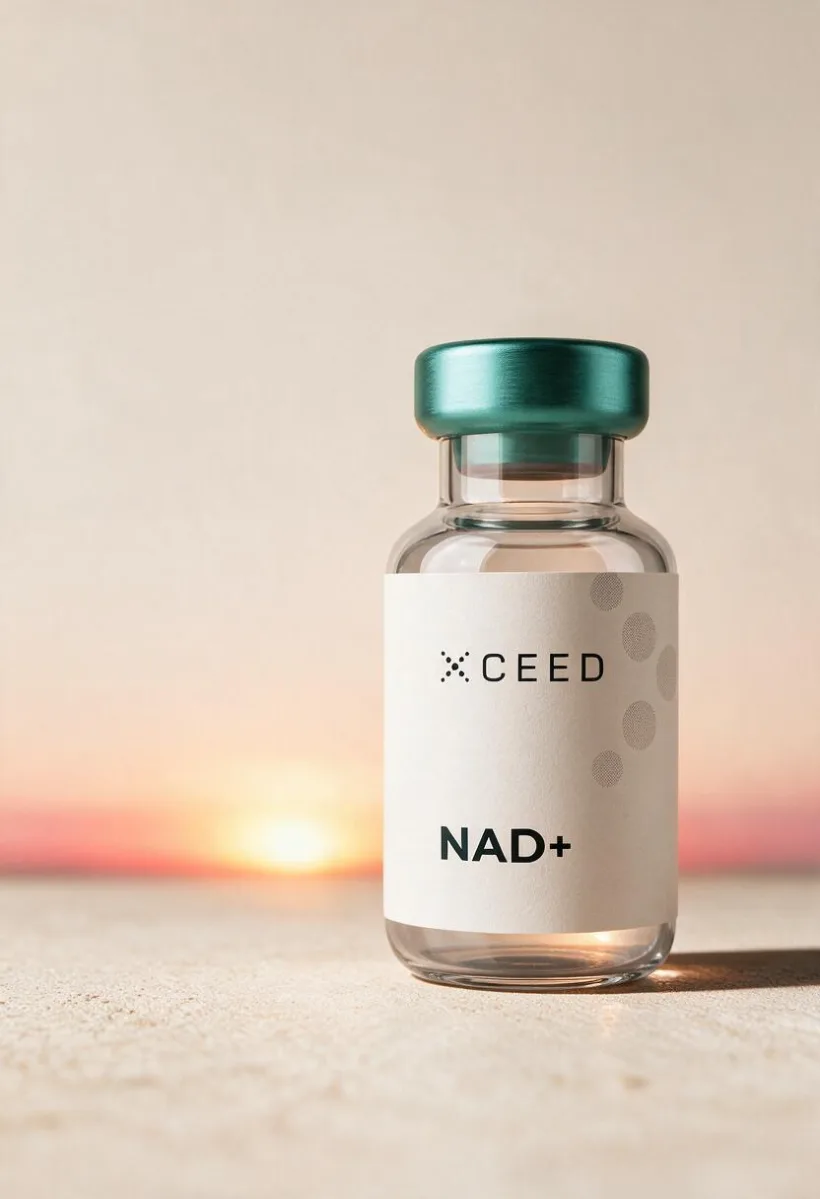
NAD+ vial Physician-reviewed before it ships

What it is

What NAD+ is

NAD+, short for nicotinamide adenine dinucleotide, is a coenzyme present in all living cells. It plays a central role in metabolism, helping cells convert nutrients into usable energy and taking part in many basic cellular processes. Levels of NAD+ are known to decline with age. NAD+ offered through XCeed is compounded, and is offered as an injectable and as an oral melt. Beyond that established biology, we make no claims about what supplemental NAD+ will do for you. Whether it fits your goals is a decision for a licensed physician.

The evidence

What the research says, and what it does not

The role of NAD+ inside the cell is well established, and its decline with age is documented. What is far less settled is whether raising NAD+ through injections produces a meaningful health benefit in people. Much of the promising work involves cells, animals, or NAD+ precursor supplements rather than injectable NAD+ itself, and the human evidence is still early. We present the research so you can be informed and ask your physician detailed questions. We make no claims about what NAD+ will do for you.

Human
Grant, Berg, Mestayer et al. (2019) — Frontiers in Aging Neuroscience 11:257

The one published human study in which NAD+ itself was given, rather than a precursor. Eight participants received NAD+ by intravenous infusion over six hours while blood and urine levels were tracked. Plasma levels did not change measurably until after two hours. Two things to note: this is intravenous, not the injection offered here, and it measured levels rather than health outcomes.

Human
Martens, Denman, Mazzo et al. (2018) — Nature Communications 9:1286

A precursor, taken orally, not injectable NAD+. A crossover trial in healthy middle-aged and older adults measuring tolerability and blood NAD+ levels during six weeks of oral nicotinamide riboside.

Human
Yoshino, Yoshino, Kayser et al. (2021) — Science 372(6547):1224–29

A ten-week randomised, placebo-controlled trial of nicotinamide mononucleotide in 25 postmenopausal women, measuring muscle insulin sensitivity. Three things differ from the product on this page: it is a precursor rather than NAD+, it was taken orally rather than injected, and the participants had prediabetes.

Meta-analysis
Chen, Zhou, Kong et al. (2024) — Current Diabetes Reports 25:4

Pooled eight randomised trials covering 342 adults and found no significant benefit of nicotinamide mononucleotide on fasting glucose, fasting insulin, HbA1c, insulin resistance or lipid profile. A precursor again, and a null result.

How to read this list: there is one published human study of directly administered NAD+, Grant 2019, and it was intravenous and tracked levels only. Everything else above is a different molecule, a precursor, or a different route, taken orally, or both. We keep those apart rather than presenting one as evidence for the other.

Safety

Safety and what to discuss with your physician

A licensed physician reviews your history and decides whether NAD+ is appropriate for you, and monitors you while you are on protocol. Reactions at the injection site, such as redness or discomfort, can occur. With NAD+ given too quickly, people have reported sensations such as flushing, nausea, chest tightness, or cramping, which is one reason a physician guides how it is used. People who are pregnant or breastfeeding, and anyone with a significant medical condition, should review it with a physician first.

The process

How to get NAD+ through XCeed

01

Tell us your goal

Complete a short medical intake.

02

A physician decides

If a protocol is right for you, they prescribe it. If it is not, they tell you.

03

Delivered, with a coach

A US-based pharmacy dispenses it, and the Avida app and a coach come with it.

See if it is right for you

No.Compounded · not FDA-approved

Is NAD+ FDA-approved?

No. NAD+ offered through XCeed is compounded and is not FDA-approved. It is prescribed by a licensed physician and dispensed by a licensed US-based pharmacy.

Questions

Frequently asked questions

Is NAD+ FDA-approved?

No. What you would receive is compounded and is not FDA-approved.

What is NAD+?

A coenzyme found in every cell that plays a central role in how cells produce energy. Its levels decline with age.

Does an NAD+ injection work?

The biology of NAD+ is well understood, but whether raising it by injection produces a health benefit in people is not well established. We do not promise a result. Your physician can talk through what is and is not known.

Do I need a prescription?

Yes. A licensed physician reviews your intake and decides before anything is dispensed.

How is it taken?

As an injection, or as an oral melt that dissolves in the mouth. Your physician sets the specifics and can help you choose between them.

Start here

Want to talk to a physician about NAD+?

Start with a short intake. A licensed physician decides what, if anything, is right for you.